Wednesday, April 27, 2011

Fring 4-way Video Chat, Out of Beta


We first mentioned Fring in July of last year. They have been working on an application that rocks videochat on a handheld to something of a new level. Then earlier this month they released the Beta. If this is all new to you like it is to me, they designed an application that will set up a video chat room for up to four people at once. It’s available for both Android and iOS.


Fring released this promo video showing you the way this will allow you to connect with groups of friends to create unique personal moments of joy and beauty. It’s a fun little advertising spot and really does showcase the possibilities with this kind of technology. I especially enjoyed the short scene that implies you should take your friends with you when you’re peeing in public. It reminds me of a friend who would tweet their toilet shenanigans with alarming regularity, pun intended.
One thing I noticed…

Fringing? Really? It always bothers me when marketers jump forward like that and try mutate their own memes. It always looks and feels hokey and artificial. Listen up, let the meme pools do their work, that’s what they’re for. Google never wanted “google” to be an English verb (publicly anyway), that just evolved naturally out of the language.
Linguistic foibles and tangents aside, this app seems to be a similar tool to Cloudtalk, except Cloudtalk is more focused on asynchronous messaging, where there can be a significant time delay in response. Fring is more about synchronous messaging, where all parties are streaming the video data up and downstream at the same time. This is a good sign for the app ecosystems. These are similar, but slightly different applications that might be competing to fill a similar, but distinctly different, niche. Which do you prefer?

Nexus S smartphone works after soaring to 32K meters on a weather balloon

Folks from Google and some other space enthusiasts got together recently and ran an experiment with the new Samsung Nexus S smartphone to see just how well the smartphone sensors and accelerometers worked when the temperatures decreased. The test involved several smartphones and a trip to the stratosphere.


Engineers from Google and students from the University of California put the Nexus S smartphones into special coolers with GPS antennas on them, tied them to weather balloons, and then let them go. The balloons were able to reach 32,000 meters above the ground before the balloons burst and the phones started the plummeting decent.
The phones and their special coolers were brought to the ground using parachutes and the decent from height took 20 to 30 minutes. After the smartphones were retrieved, they still worked despite the extreme temperatures at the heights the balloons reached.

Friday, March 25, 2011

Oracle: Making Extraordinary Profits


The company’s revenue is increased by 37% and net income increased by 78%. So to celebrate their success they are giving 20% dividend to their shareholders new software license sales jumped 29% to $2.2bn in the third quarter.


Oracle made net income for the quarter of $2.1bn up from $1.2bn a year earlier. The company is in a battle with rivals IBM, Cisco Systems and HP to provide infrastructure for companies to move to "cloud computing" the remote storage and handling of data.

Japan provides 5% of the company's revenues but Oracle executives told analysts they saw no material impact from the disruptions to production caused by the earthquake and tsunami.


To learn more about oracle  visit

http://www.oracle.com/index.html

Sunday, March 20, 2011

Hackers Have Made Their Move


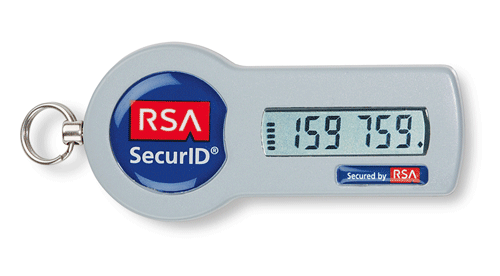
Hackers have made their move and stole security tokens of millions of people which they used in order to guard right to use of their bank accounts and corporate data. RSA Security told customers about the "extremely sophisticated cyber attack" in an open letter posted online.

The company is providing immediate advices to customers to limit the effect of the cyber attack. It is also advising their customers to increase the security measures for their accounts i.e. password strength and other security questions.

Saturday, March 12, 2011

Destructions Caused By the 8.9 magnitude Earth Quack In Japan

On Friday the 8.9 magnitude earthquack has been confirmed as the fifth strongest earthquack on the earth in the past 100 years. More than 50 aftershocks and Officials say that more than 1,000 people are thought to have died with the 10,000 people are missing and these statistics could rise significantly.


One of the worst-hit areas was the port city of
Sendai.A huge rescue and recovery operation is going on as Japan tries to deal with the Friday's earthquake. Moreover,A large explosion has occurred at the Fukushima I - nuclear power plant in north-eastern Japan, close to the epicentre of Friday's earthquake. Officials fear a meltdown at one of the plant's reactors. Tens of thousands of people in the surrounding area have been evacuated. This 8.9 magnitude quake also caused tsunami at the pacific cost.

 
So at the time of this great sorrow and loss its the responsibility of all of us to help the Japanese people in whatever way u can.

donate online

FOR MORE INFO CLICK HERE

Friday, March 11, 2011

BRAIN : Search For The First Computer Virus


Google's Person Finder Service to Help Japan Earthquake Victims

Google has launched Person Finder service to help the people suffered from the earthquake. The website acts as a directory and message portal so people can look for their lost relatives and friends or can inform about their status by posting a note. In order to increase its usage Google will integrate it with the web especially with social networking sites so that large no of people can be benefit by this service. After the Japan earth quake this service has logged on by about 4000 people.

 The extent of the damage caused by the Japanese earthquake is not yet known but its 8.9 magnitude can cause across the Pacific region which can make its more disastrous by effecting 10’s of thousands of people and in such situations this service will be a blessing. Google's Person finder was used in the aftermath of the 2011 NewZealand earthquake.

 Before these kind of tools such as Person Finder it was much harder to compare the information gathered by separate agencies and help to re-unite families and friends. The system was first used following the Haiti earthquake in January 2010. That first tool was based around work done in the aftermath of Hurricane Katrina that hit New Orleans.