Thursday, March 3, 2011

"Battle of the Tablets"


Judged on specs alone, the Apple iPad 2 doesn't do much more than keep pace with its tablet rivals. It's a bit thinner that its major rivals--the Motorola Xoom, the Samsung Galaxy Tab 10.1, the HP TouchPad , and the RIM BlackBerry Playbook--and it's lighter than most. But its processor appears to be on a par with those of other tablets, and its cameras' resolutions seem to be lower.

Of course, people don't buy tablets based on specs alone. The iPad 2 will carry a base price ($499) that no major competitor has managed to match; it will come with a new version of iOS, a mobile operating system that many people prefer; and owners will have access to vastly more apps than are available for any other tablet. Plus, Steve Jobs promised that the iPad 2 would ship on March 11. Of the competing tablets we looked at, only the Xoom is already shipping. There are no hard availability dates for the other competitors.

Apple has shaved off a third of the thickness of the original iPad in the iPad 2, making it the thinnest tablet in this comparison. At 1.35 pounds, the iPad 2 is also lighter, on a par with Samsung's Galaxy Tab 10.1 tablet as the lightest of the roughly 10-inch-screen tablets. Motorola's Xoom and HP's TouchPad are slightly heavier at 1.6 pounds.

Apple didn't change the display of the iPad 2: As on the original iPad, it has a 1024-by-768-pixel resolution and a 9.7-inch size (same as the TouchPad). The Android tablets from Motorola and Samsung have 10.1-inch screens with 1280-by-800-pixel resolution.

The iPad 2 will have the largest available built-in storage (64GB), but the Xoom probably trumps that advantage by providing 32GB of internal storage plus expandable storage via an SD Card in a future software update.

The iPad 2 is also stronger under the hood. It packs an Apple A5 dual-core 1GHz processor, putting it on the same level with all of the other tablets in the comparison except the TouchPad, which will have a 1.2GHz dual-core processor (the fastest pure clock speed of this comparison). Of course, clock speed and number of cores don't in themselves determine how fast a tablet is or how well it manages power. That determination will require side-by-side testing.

Apple isn't saying how much RAM the iPad 2 contains (the original had 256MB, some are speculating that the new version has at least 512MB), but the Xoom, the TouchPad, and the BlackBerry PlayBook have 1GB of RAM inside.

The iPad needed front- and rear-facing cameras to keep pace with the competition, so Apple added a front-facing camera for video calling and a second camera on the back. Apple didn't specify the megapixel count of the back-facing camera, beyond saying that it records 720p HD video. Nevertheless, even with the new additions, Apple appears to trail in megapixel count, especially when matched against the Galaxy Tab 10.1's 2-megapixel and 8-megapixel cameras.

Apple has improved the speaker on the iPad 2, introducing a larger, wider grill. But all of its rivals have stereo speakers.

The iPad 2 will come in two separate 3G models--one for Verizon and the other for AT&T--alongside the Wi-Fi-only model. Both the Xoom and the Galaxy Tab will come only in a 3G version initially, with Wi-Fi only versions to follow. For its part, the TouchPad will come only with Wi-Fi support at the beginning, with 3G versions to follow.

The Xoom will soon be the only 4G tablet, however. Motorola has said that the Xoom can receive a free 4G radio update soon......

Don't get your hopes up too high for iPad 2, iPad 3 is the tablet to watch

Yesterday's highly anticipated iPad 2 announcement showcased a faster, sleeker tablet with many expected upgrades... but none of the big surprises that constitute a "wow factor.". A new report suggests the upcoming iPad2 will be a minor upgrade. However, its future replacement--let's call it the iPad 3 --will be a super-duper slate that rocks the tablet world. This latest gossip arrives courtesy the Cult of Mac blog, which reportedly got the inside dirt on the upcoming iPads from an anonymous Apple staffer. The source didn't divulge details on the iPad 2 or 3, but did provide this insight:

"For the iPad 2 don't get your hopes up too high. That's all I'm going to say. They've had a number of problems along the way, and the third-generation iPad is the one to make a song and a dance about."

The remarks about "problems along the way" may explain why Apple has waited until March to announce the iPad 2. The company usually adheres to an annual refresh cycle for its products-a new iPhone in the summer, for instance, and new iPods in the fall-a schedule that suggests the iPad 2 launch is a month or so overdue. (The original iPad debuted in January 2010 and shipped in April.)

The Apple staffer's lack of enthusiasm for the iPad 2 and praise for the iPad 3, which recent reports say will ship later this year, are in line with what IDC analyst Tom Mainelli.

At the time, Taiwanese trade publication Digitimes was reporting that the iPad 2 would have a screen resolution of 2048 by 1536 pixels--four times that of the current 1024-by-768 pixels.

Mainelli, however, believed the 2048-by-1536 pixels prediction was premature: "Our sources say Apple has requested that manufacturers begin work on displays with that resolution for the iPad 3," said Mainelli, who didn't predict when Apple's third-gen tablet might ship.


So if the iPad 3 is the tablet to watch, what can we expect from the less-magical iPad 2? Apple will reveal all, of course, but the expected upgrades include a thinner and lighter design; front- and rear-facing cameras; a larger speaker; a faster processor; more RAM; and possibly a dual-mode wireless chip for CDMA and GSM networks.

New Apple iPad 2.....Less in your Hands More At Your Finger Tips

CEO of the Apple incorporation Mr. Steve Jobs has launched the 2nd generation of the iPads at San Francisco. Apple was the first company to introduce iPads. At the beginning it almost ruled the iPad market. But during the past few years it had a tough competition from its rivals like HP, Samsung, HTC etc. which is mainly due to the GOOGLE’s open source Android system. So in order to have its discrete position in market Apple comes up with the 2nd generation of iPads.


According to the officials this 2nd generation is thin, lighter and has faster processing, more improved graphics,improved software and front and rear end cameras with 10 hour lasting battery. These iPads are integrated with the Apple’s latest core A5 processor which provides it double processing power than the previous iPads.

 
This iPad2 will be available in 27 countries of the world till March 25 this year. It will have the initial price between $499 and $826.

Tuesday, March 1, 2011

Robots On the track . . . Get set go. . . !!!!

The world’s first robo race was held in Osaka Japan. This race is organized by a Japanized based robot  manufacturing firm along with the help of the Osaka administrating authorities. In this race small two legged robots took part.


It was four days long event in which the robots have to cover 423 laps of an indoor track in which the robots can have a new battery and can change machines during the race but if they fell down they have to get up on their own again otherwise it was disqualified from the race.


The race begins on Thursday and a large number of audiences showed up at the event to watch the start of this 42km marathon. At the end the Robovie PC wins this first ever robot race .

Watch it..


Monday, February 28, 2011

Top 5 Worth Buying Android Smart Phones

1. Samsung Galaxy S

Samsung has become the leading Android smartphones company after the launch of its Galaxy and Galaxy S is said to be  the most popular Android phone yet.
It has 1 GHz ARM Cortex-A8 processor, PowerVR SGX540 GPU, Hummingbird chipset, 8 GB/16GB storage, 512 MB RAM, 2GB ROM , 5 MP, 2592 x 1944 pixels camera with autofocus with Geo-tagging, touch focus, face and smile detection features. 

It has 480 x 800 pixels, 4.0 inches wide Gorilla Glass display with
- TouchWiz 3.0 UI
- Multi-touch input method
- Accelerometer sensor for UI auto-rotate
- Touch-sensitive controls
- Proximity sensor for auto turn-off
- Swype text input

2. Motorola Atrix 4G

The Motorola Atrix 4G is also a dual core Nvidia Tegra 2 dual core Android smartphone which runs Android 2.2 Froyo with an Android 2.3 Gingerbread upgrade in the pipeline. It has everything which makes a smartphone attractive.

 It has 1 GHz dual core Nvidia Tegra 2 processor, 1 GB RAM, 5 MP camera and can record 720p videos, 16 GB internal memory and , and a 4.0 inch display with a resolution of 960 x 540 pixels. It supports 3G HSDPA connectivity with Bluetooth, Wi-Fi, GPS etc. due to its webtop dock it can also be converted to a netbook.

3. LG Optimus 2X

The very first dual core smartphone which is integrated with 1 GHz Nvidia Tegra 2 dual core processor. Its 512 MB RAM and an 8 MP camera with autofocus and LED flash makes it the first choice of the buyers.

 It run Android 2.2 Froyo and has a 4 inch TFT capacitive touchscreen display and can record 1080p video as well. It has GPRS, EDGE, 3G HSDPA, Wi-Fi, Bluetooth, GPS etc.

4. Motorola Droid Bionic

Droid Bionic also has a dual core Nvidia Tegra 2 processor with 512 MB RAM. It runs the  Android 2.2 Froyo operating system. It comes with both 3G and 4G connectivity.

 It has 4.3 HD display with a resolution of 960 x 540 pixels, an 8 MP camera with autofocus and dual LED flash and can record 720p videos at 30 FPS.

5. Sony Ericsson Xperia Arc

The Xperia Arc has very sleek and stylish design. It has a 1 GHz Snapdragon processor, 512 MB RAM and an Adreno 205 GPU. 
It comes with 16 GB internal storage and runs Android 2.3 Gingerbread operating system.It has a 4.2 inch LED backlit capacitive display and comes with an 8 MP camera with autofocus and LED flash. It can record 720p HD video and includes GPRS, EDGE, 3G, Wi-Fi, Bluetooth, GPS etc.

Sunday, February 27, 2011

Application Developers can Enable Doctors To Detect Tumors Via Smart Phones

Many people say that the cell phones causes cancer and some says it doesn't but one thing which the Researchers at Massachusetts General Hospital proved is that they can be used to detect tumors. At Boston have developed a system can detect tumors by analyzing a few thousands cells and spare patients from the larger biopsies currently used. It works by using magnetic nanoparticles to measure protein levels, looking for specific markers that indicate the presence of cancer. Doctors can see the information from the chip on their phone's screen.

To test this device the Researchers have conducted two tests in both of them they get quite good results even in the second test the accuracy is about 100%. The smart-phone-equipped device is also much faster than current methods, providing results in under an hour which is way faster than the usual three day wait.

According to the researchers this device isn't quite ready for clinical use. One problem is that the relevant protein markers aren't always present in cancer cells, which could lead to misdiagnoses. The proteins are also short-lived, meaning that cells should be analyzed soon after they are extracted.

Google Goggles for online image and facial recognition


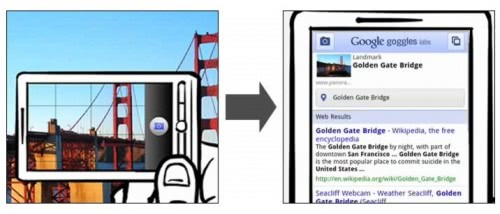
Google introduced Google Goggles which is an image recognition search for mobile phones which allows the users to capture anything like a building, landmark or monument from their mobile phone camera and then they can get info about that photo by searching using GOOGLE GOGGLES.  A user does not need to type or speak to start the search. It's as easy as opening the app, taking a photo and then waiting for the search results. 
 
 When you capture a photo it also includes background like streets, signboards, people etc. and when you search for that image Google may break the photo into all those different background pieces and then search for each piece including facial recognition searches. 

 After the search has matched it will search the applications like social networking applications, calendar applications, in order to create identities list included in the photo. It also mentions that if the photo is tagged that photo can be used for the future identification. In order to ensure privacy Google send a request after a person has identified weather the image can be search result for other searches within the person’s social network.


Governments and the law enforcement Agencies are already identifying people based upon real names and photos posted in social media. This service by Google has both the positive and the negative aspect, at one side you can identify criminals and terrorists using this technique with the surveillance cameras in case of any accident but on the other hand you have to compromise privacy a bit. 

Have a look at it